




Jun 22,2020
What are the common types of machining?
Machining actually has many forms; machining refers to the process of using industrial equipment to change the specifications or characteristics of steel parts. What types of machining are currently more commonly used? Today, we will introduce a few in detail. Milling (lathe, horizontal): Milling is the removal of steel from metallic materials. In addition to rotating the steel, NC blades select steel or mill along the steel.
Jun 22,2020
The role of machine tool fixtures in machining is very important.
Traditional machining methods mainly include: turning, milling, planing, grinding, drilling, boring, etc. Machining is divided into: cold processing, hot processing, chemical processing, and special processing. There are many methods, the processes are rigorous, the technical content is high, it involves a wide range of disciplines, there are many practitioners, and it contributes greatly to society. When it comes to machining, we must understand one of its important tools, which is our machine tool fixtures, and what role they play in our machining.
Jun 23,2020
What are the safety precautions to take during machining?
There are three detailed principles for the disposal of machining: First, to ensure processing accuracy, rough and finish machining should ideally be separated. During rough machining, the cutting amount is large, and the workpiece experiences significant cutting force and clamping force, resulting in considerable heat generation, as well as noticeable work hardening on the surface. There are also large internal stresses within the workpiece. If rough and finish machining are performed continuously, the accuracy of the finished parts may quickly be lost due to the redistribution of stresses. For certain parts that require high processing accuracy, low-temperature annealing or aging treatment processes should be arranged after rough machining and before finish machining to eliminate internal stresses.
Jun 23,2020
How to make products made by CNC machining more precise
CNC machining is a process widely used in the machinery industry, referring to the process of stopping part processing on CNC machine tools. In CNC machining, CNC machine tools, CNC systems, etc., are used. A CNC machine tool is a machine tool controlled by a computer, while the instructions of the CNC system are a set of instructions compiled by programmers based on the material of the workpiece, processing requests, characteristics of the machine tool, and the instruction format specified by the system.
Jun 24,2020
Reasons for errors during mechanical processing
The errors in the machining process mainly include spindle rotation error, guide rail error, and transmission chain error. The spindle rotation error refers to the variation of the actual rotation axis of the spindle at each moment relative to its average rotation axis, which will directly affect the precision of the workpiece being processed.
Jun 24,2020
How to ensure the qualification rate of machined parts leaving the factory
The mechanical parts processing industry is a pillar of the national economy and has a very promising outlook. When processing precision mechanical parts in a machining factory, there are many requests and regulations regarding the processing technology to ensure the qualification rate of the parts produced.
Jun 28,2020
Advantages of Large CNC Machining Centers
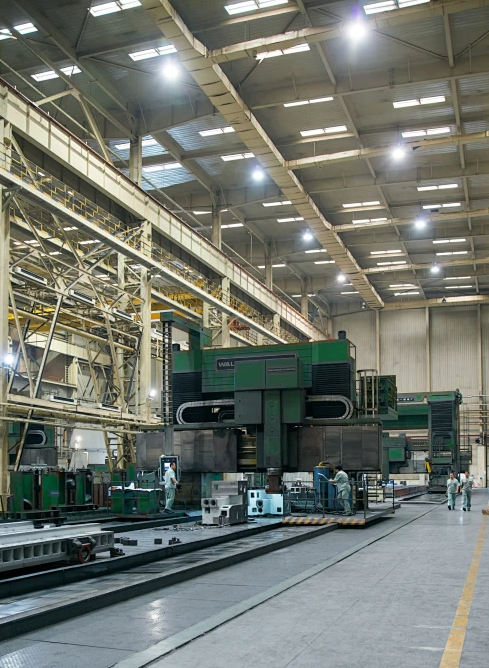
Mold processing is an industry that cannot be ignored in the current industrial consumption process, and this industry has strict requirements for machines. The large CNC machining center is capable of meeting production needs. The operation of this machine is fully integrated with computers, thus showing many advantages in use.
Jun 28,2020
Formulate the process for machining products.
The consumption process of machines in a machining factory refers to the entire process from raw materials to finished products. For machine consumption, it includes the transportation and storage of raw materials, preparation for consumption, manufacturing of blanks, processing and heat treatment of parts, assembly and debugging of products, painting, and packaging.
Jun 28,2020
Share a few benchmark issues in machining
The design reference for precision machining is used on part drawings to confirm the reference points, lines, and surfaces of other locations, known as the design reference. For the shaft sleeve parts in precision machining, the design reference for all outer circles and inner holes is the axis of the part, with end face A serving as the design reference for end faces B and C, and the axis of the inner hole being the reference for the radial runout of the outer circle.
Jun 29,2020
How to design process references for machining mechanical parts
Mechanical parts are composed of several surfaces. To study the relative relationship of the surfaces, a reference must be established. The reference is the point, line, or plane on the part used to determine the position of other points, lines, and planes. Depending on the different functions of the reference, it can be divided into two categories: design reference and process reference.
Related dynamics
Contact Us
E-mail:tjjiaxuyan@163.com
Telephone:022-68976188,13821612718
Mobile:18902087888,13802191288
Address:Fengjia Village, Duliu Town, Jinghai District, Tianjin

Tianjin Jinghai County Jia Xuyan Hydraulic Machinery Co., Ltd.
Address: Fengjia Village, Duliu Town, Jinghai District, Tianjin
Contact:18902087888,13802191288


Online consultation
* Note: We will contact you within 1 working day, please check.